about

Liquid Tiles

Kinetic canvas

Frankfurt.. March 2026


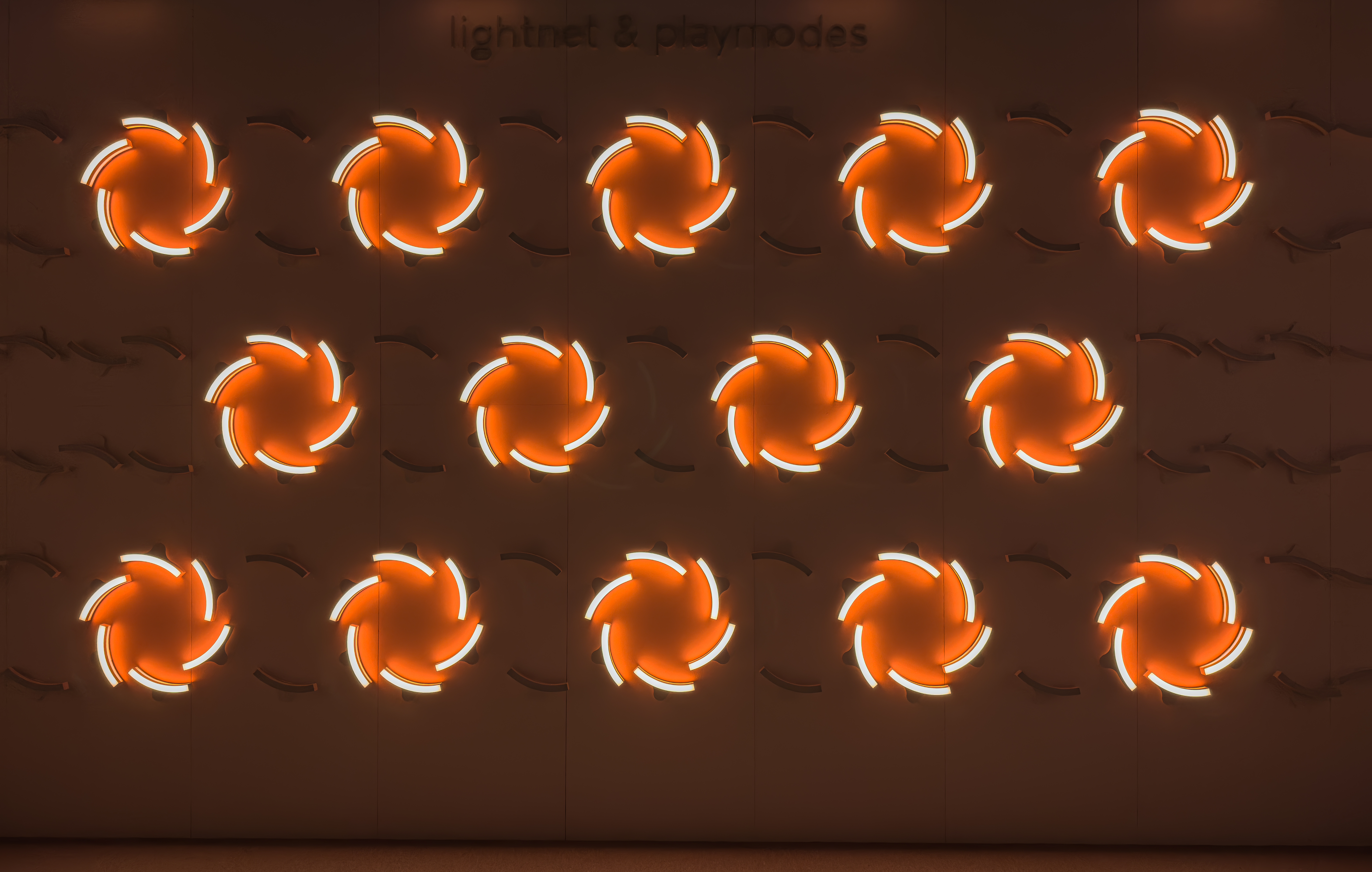
Liquid Tiles is a kinetic audiovisual canvas conceived as a modular system of 126 computer-controlled rotating light fixtures arranged in a triangular matrix. Each fixture is a curved 60-degree segment which, through its geometric disposition, forms a continuous connective tessellation known as Truchet tiling, named after the 18th-century mathematician Sébastien Truchet. This structure enables local interactions between elements to propagate across the surface, generating larger, evolving visual patterns. At its core, Liquid Tiles explores the emergence of organic behavior from mechanical and digital systems. Although driven by robotics and custom software, the installation reveals a sense of vitality arising from simple rule-based processes. Generative algorithms define constraints for movement, geometry, color, and sound, within which the system continuously recomposes itself. The result is a stream of ever-evolving light and sound configurations that behave like a quasi-living organism, blurring distinctions between physical and digital, programmed and organic. The artwork is the outcome of a close collaboration between Lightnet, a German lighting manufacturer, and Playmodes. All firmware, software, and generative systems were developed specifically by the artists for this installation, while the hardware components were researched, engineered, and manufactured in-house by Lightnet through a shared design process inspired by the Liquid Line product ensemble. Liquid Tiles stands as a living example of how collaboration between industry and the arts can open new perspectives on industrial innovation, contemporary lighting design, and digital art practice.


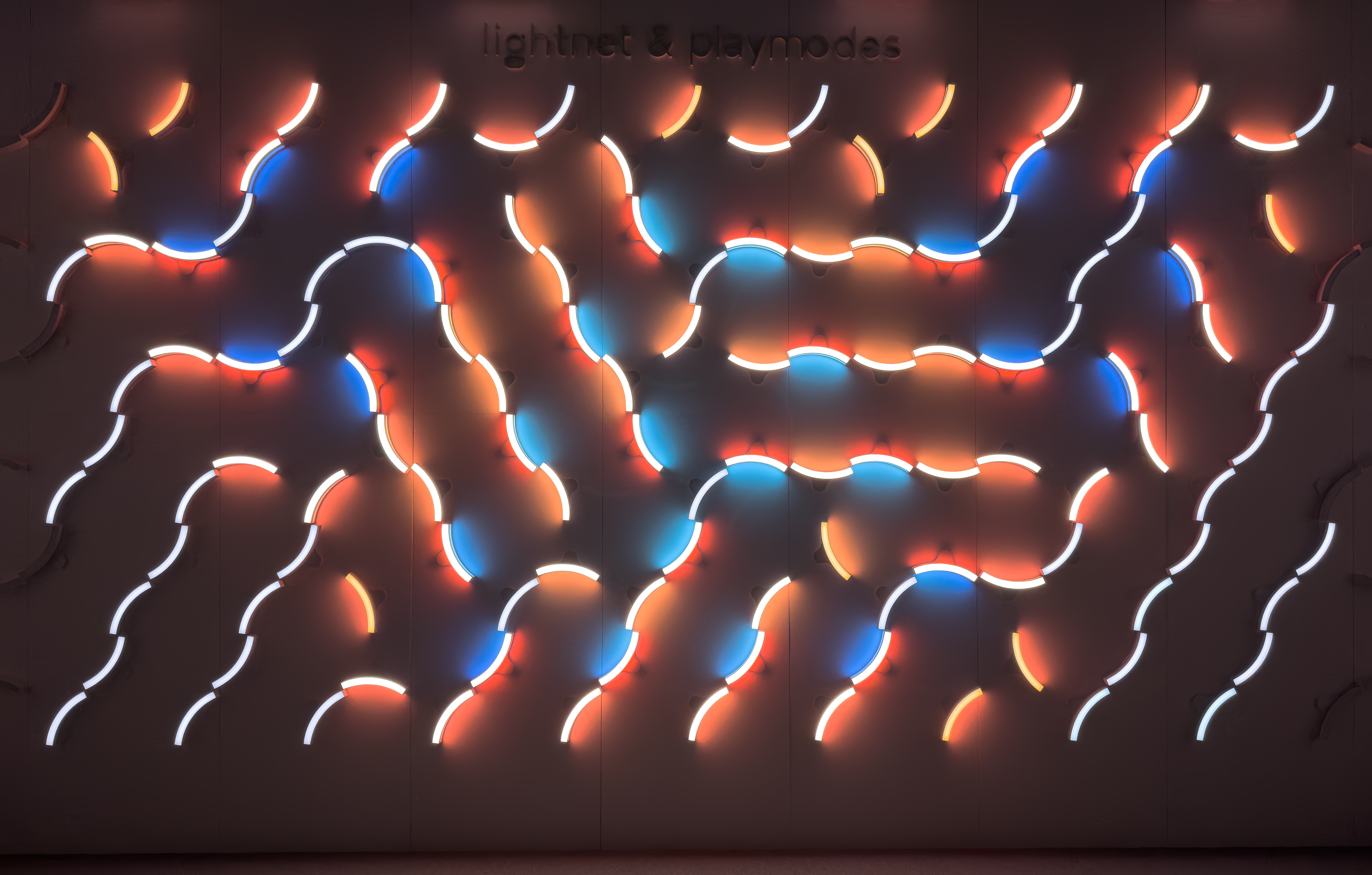
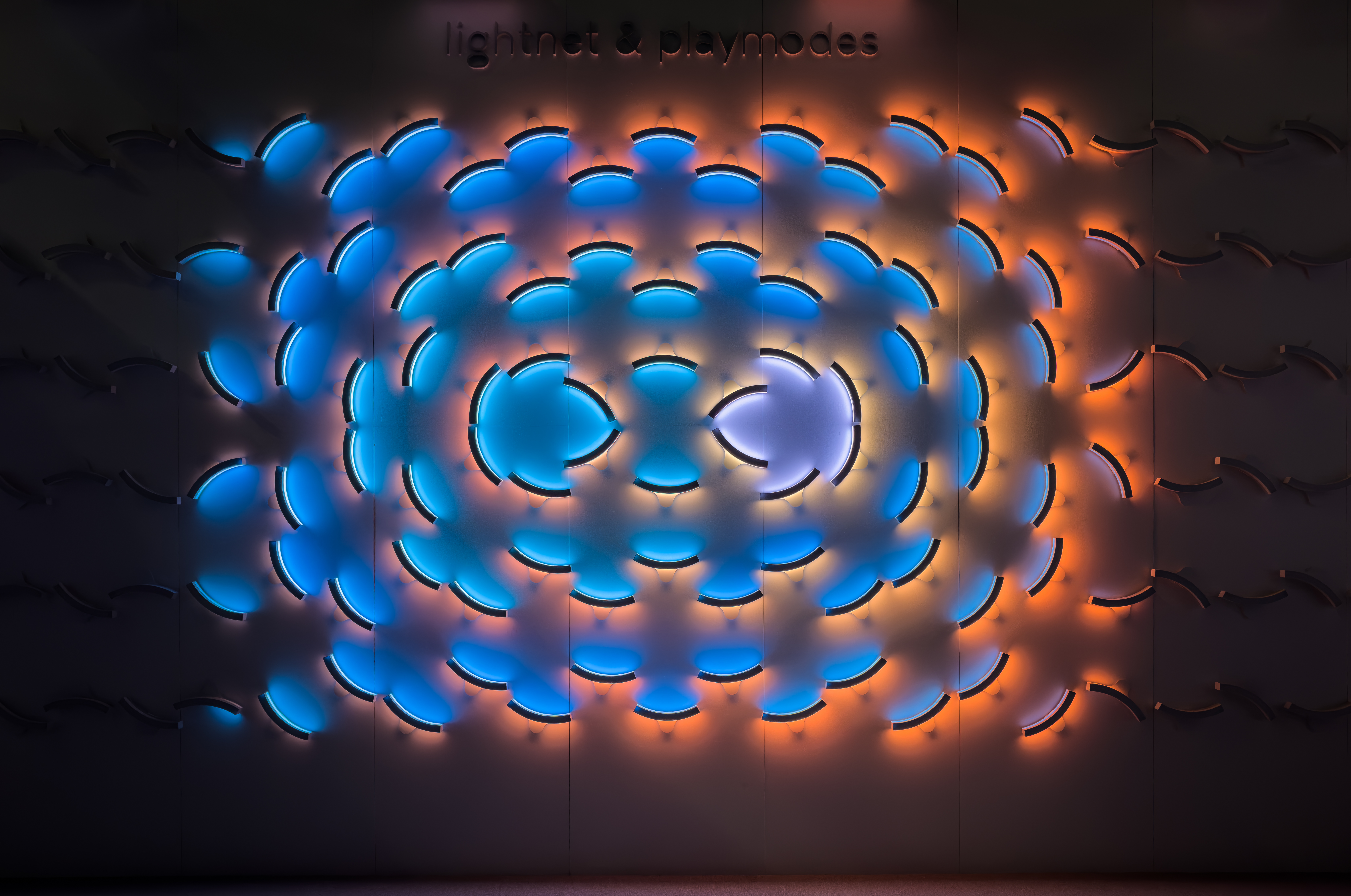
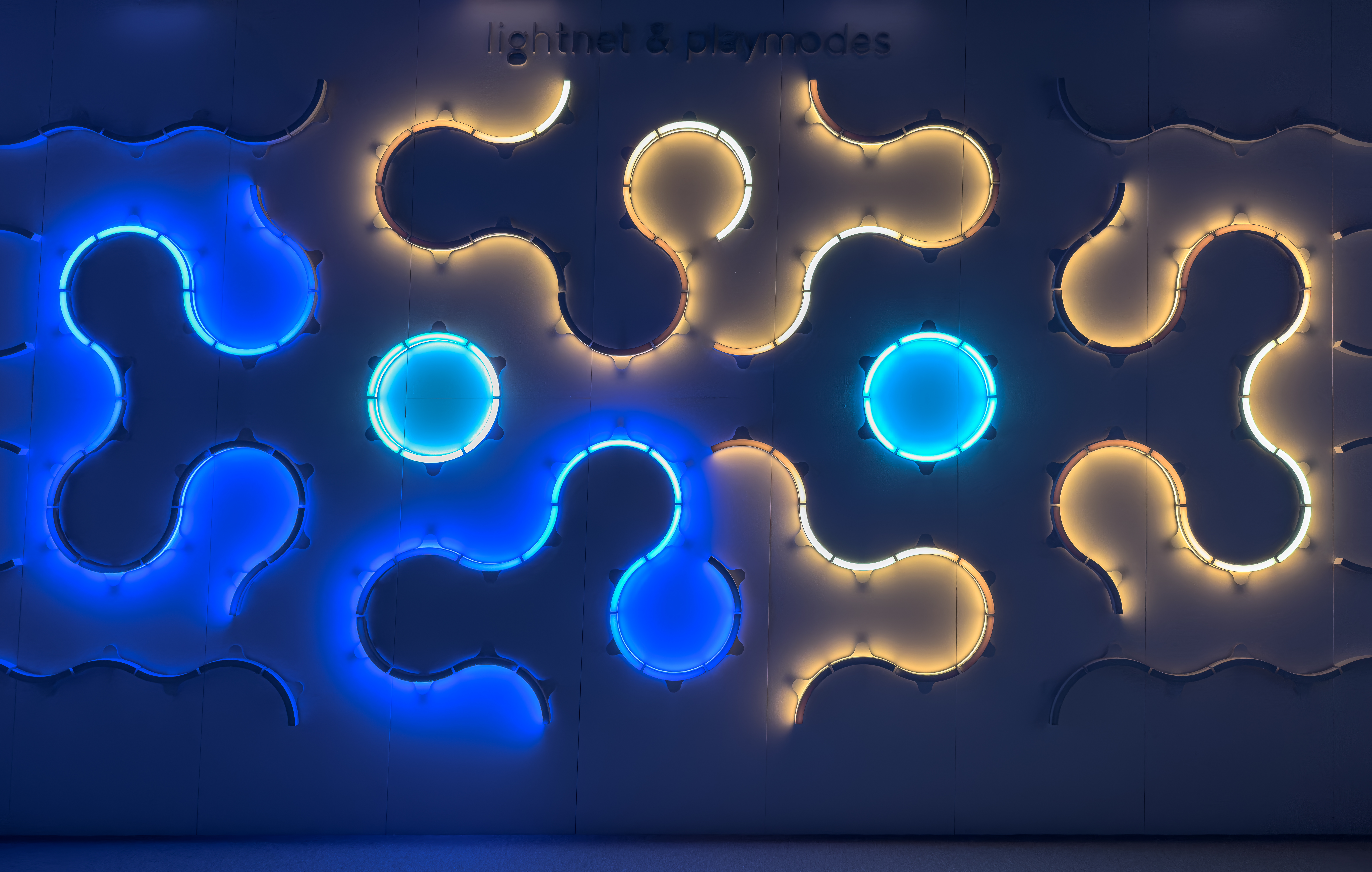
Liquid Tiles encompasses a number of "behaviors". Sets of ruls that, when deployed by the software system, give rise to an eclectic collection of audiovisual results. Find here some brief descriptions of each of those behaviors: FULLER An algorithm periodically generates compositions of closed shapes. As it searches for ways to fill the canvas, it produces a never ending field of combinations that reveals the versatility and flexibility of the modular system. Large structures can emerge that recall natural phenomena—corals, fungi, microorganisms—while smaller interlocking cells gather into shifting constellations. At times, the behaviour even suggests characters from an extraterrestrial script. From a simple set of rules, complexity and emergent beauty unfold through permutation. SPAGHETTI -Take a few boiled spaghettis and throw them over the table. -Get a couple of mirrors and reflect the resulting spaghetti composition. -Make the spaghettis shine and cast light to the sides. You’ll get the most delicious and bright dish for your hypnotic dreams! This behaviour is driven by controlled, periodic randomisation of the arc angles. All elements shift simultaneously, yet the algorithm favours local continuity, encouraging the formation of long, meandering zig-zag paths — the “spaghettis.” These strands weave across the canvas and, through mirroring, transform apparent randomness into a loose and playful symmetry. A dreamy soundscape follows the stretching and realignment of these luminous lines, accompanying the slow cooking of this ever-changing geometric dish. FEATHER A soft, continuous motion spreads across the matrix as if guided by an invisible wind. The arcs no longer behave as individual elements but as parts of a shared surface, bending and aligning through smooth gradients of change. Patterns emerge that recall feathers, fish scales, or fields of grain set in motion by air currents. This behavior is generated by a two-dimensional Perlin noise applied simultaneously to rotation and color. Small local variations propagate into larger coherent drifts, producing flow-like structures similar to those found in natural phenomena such as fluid dynamics, animal camouflage, or morphogenesis. The sonic layer is derived directly from the same vector field. Variations in intensity, velocity, orientation, and luminosity are translated into sound, so that every ripple in the visual flow leaves an acoustic trace. What we perceive is not an image accompanied by music, but a single evolving phenomenon expressed through two sensory domains — an audiovisual organism continuously reshaping itself in time. SNAKE A path assembles itself arc by arc, forming a growing zig-zagging body that navigates the matrix like a curious creature. Each new segment attaches at the head, extending the chain while carefully avoiding collisions with its own body or the limits of the canvas. The system continuously searches for a valid continuation, turning spatial constraint into a playful process of growth. When no further move is possible, the structure reaches its limit: the game is over. The canvas clears and a new snake is born, restarting the cycle of emergence and expansion — a gentle nod to early arcade logic. KALEIDOSCOPE A rotating kaleidoscopic pattern unfolds across the canvas, continuously recombining itself into fleeting constellations of flowers, stars, and radiant geometries. Symmetries appear, dissolve, and reassemble in a slow, hypnotic drift, as if the surface were endlessly folding onto itself. Moments of visual convergence briefly reveal the precise geometric structure underlying the apparent complexity, before it dissolves again into motion — a balance between order and ornament, mathematics and perception. DUALITY A symmetric choreography of two light entities exploring the limits of its relation. They dance around the canvas seeking for each other, expressing their will to communicate and interact with it's counterpart. A story that mimics human relations, where balance, symbiosis and symmetry guide this duality algorithmic expression. Driven by randomness and a complex set of rules the story is told through an emotional trip of light, color and sound.
+info: LiquidTiles_Dossier Lightnet flyer